When people hear “martial arts,” they usually picture fast punches, high kicks, or intense sparring. What most don’t realize is that underneath all that action is a deep understanding of body mechanics. Martial arts aren’t just about fighting. At their core, they’re about how the human body moves efficiently, stays balanced, and generates power without self-destruction. That’s exactly why martial arts principles translate so well into caregiving, healthcare, and ergonomics.
Martial arts body mechanics start with one simple idea: the body works best when it moves as a connected system. Instead of isolating effort in the lower back, shoulders, or arms, movement comes from the ground up. Feet, legs, hips, spine, and arms all work together. This is why experienced martial artists can move smoothly for decades while others wear their bodies down much faster.
This philosophy is a major foundation of the training approach used by Eastern Ergonomics. Rather than relying on rigid rules or memorized lifting techniques, the system borrows heavily from martial arts concepts like stance, center of gravity, and alignment. These ideas are practical, intuitive, and surprisingly easy to apply once you feel them in your own body.
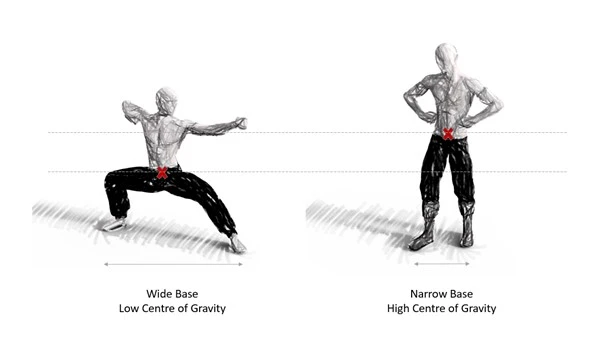
One of the most important principles is center of gravity awareness. In martial arts, losing your center means losing balance and control. The same thing happens in caregiving. When someone reaches forward, bends from the upper back, or twists under load, their center shifts away from their base. That’s when strain and injury sneak in. Martial arts mechanics teach you to stay grounded, keeping your weight over your feet so movement feels stable instead of risky.
Another big concept is using structure instead of strength. Martial artists don’t rely on brute force. They use alignment and positioning to let the skeleton do the work. In caregiving, this means learning how to position your body so you’re not “muscling through” a transfer or task. When structure is right, movements feel lighter, even when assisting someone heavier than you.
Breathing also plays a role. In martial arts, breath helps regulate tension and timing. Holding your breath during effort creates stiffness and fatigue. Coordinated breathing, on the other hand, supports smooth movement and control. When caregivers apply this idea, they often notice immediate changes. Tasks feel calmer. Movements feel less rushed. The body doesn’t brace as hard, which reduces strain over time.
What makes this approach especially effective is that it works under pressure. Caregiving environments are unpredictable. People move unexpectedly. Spaces are tight. Emotions run high. Martial arts body mechanics are designed for exactly those conditions. They don’t depend on perfect setups. They adapt to what’s happening in real time, which is why they’re so valuable outside the dojo.
Much of this crossover has been shaped and taught by practitioners like Ben Couch, who blends martial arts experience with ergonomic science. The result isn’t about turning caregivers into fighters. It’s about giving them movement tools that feel natural, repeatable, and protective even on the hardest days.
Over time, caregivers trained with these principles often report fewer aches, less fear of injury, and more confidence in their movements. That confidence matters. When the body feels capable, the mind follows. Caregivers become more present, more patient, and more effective in their interactions.
Martial arts body mechanics remind us that the human body hasn’t changed, even if our jobs have. We still move best when we’re balanced, aligned, and connected from the ground up. When those principles are respected, movement stops being something we survive and starts being something we trust.
That’s the real lesson martial arts bring to ergonomics: move with intention, protect your structure, and let your body work the way it was designed to.